AI Estimating Software for Contractors: What It Does and Does Not Do
Is AI estimating software actually useful for contractors?
AI estimating is useful for the first draft and unreliable as the final word. It is good at decomposing a described job into line items, applying quantities, and attaching current material prices — the mechanical part that eats your evenings. It is bad at knowing your local labor market, site conditions it cannot see, and the judgment calls that come from having done the job before. Treat a generated estimate as a well-organized starting point that you review, not as a quote you send unread.
How we judged
- Whether the tool generates line items or only fills a saved template
- Where material prices come from and how current they are
- Whether you can correct it and have the correction stick
- How it handles jobs it has no template for
- What it costs per estimate in practice
At a glance
| Option | Price | Best for | Watch out for |
|---|---|---|---|
| Tallie(us) | $29/mo · ~33 AI estimates/mo | Custom and varied jobs with no reusable template | Still needs your review; labor rates should be tuned to your market |
| Jobber quoting | From $49/mo | Repeatable services priced from a maintained catalog | Manual — you build and maintain the price list |
| Housecall Pro price book | From $59/mo | Flat-rate service work with standardized pricing | Strong for flat-rate, weak for one-off custom scopes |
| Dedicated takeoff software | Varies, often higher | Plan-based commercial work with real measured takeoffs | Overkill and slow for residential service jobs |
Competitor pricing verified August 3, 2026 from each vendor's public pricing page. Pricing may change.
What the AI is actually doing
When you describe a job in plain language, the system does three separable things. It decomposes the description into discrete work items. It estimates quantities for each — square footage, linear feet, unit counts. Then it attaches costs, pulling live product data for materials and applying labor rates and markup.
The decomposition and quantity steps are where it saves the most time, because that is the tedious part. The costing step is only as good as its inputs, which is why the material data source matters so much and why your labor rates need tuning to your market before you trust the totals.
Where it is reliably wrong
Be skeptical in four places. Site conditions it cannot see — access, existing damage, whether the old work was done correctly. Local labor rates, which vary enormously and which no model knows about your market by default. Anything requiring a permit or inspection, where timelines and costs are jurisdictional. And unusually complex jobs, where the plain-language description under-specifies the real work.
The useful mental model is a competent estimator who has never visited the site and does not know your crew. Their draft is worth having. Their final number is not.
Why material pricing is the part that matters
Most estimating tools ask you to maintain a price list. That list is accurate the day you build it and decays from then on. In periods when material costs move quickly, a stale list quietly erodes margin on every job priced from it.
Tallie prices line items against live supplier pricing instead, so the number reflects current cost rather than remembered cost. That is the single biggest practical difference between AI estimating and a well-organized price book, and it is worth more than the natural-language input.
How to evaluate one honestly
Pick two jobs you have already completed and know the true final cost of. Run both through the tool. Compare the generated estimate to what the job actually cost you, not to what you originally quoted.
That comparison tells you the size and direction of the error, which is the only thing you need to know to use the tool safely. Tallie's trial is 14 days with 100,000 tokens — about 3 full estimates — and requires no credit card, which is enough to run this test properly.
What we are not claiming
We do not publish an accuracy percentage for Tallie's estimates. We could generate a number, but any figure would depend so heavily on trade, region, and job type that it would be closer to marketing than measurement, and you would be right not to trust it.
Run the two-job test above and you will have a figure that is actually about your business.
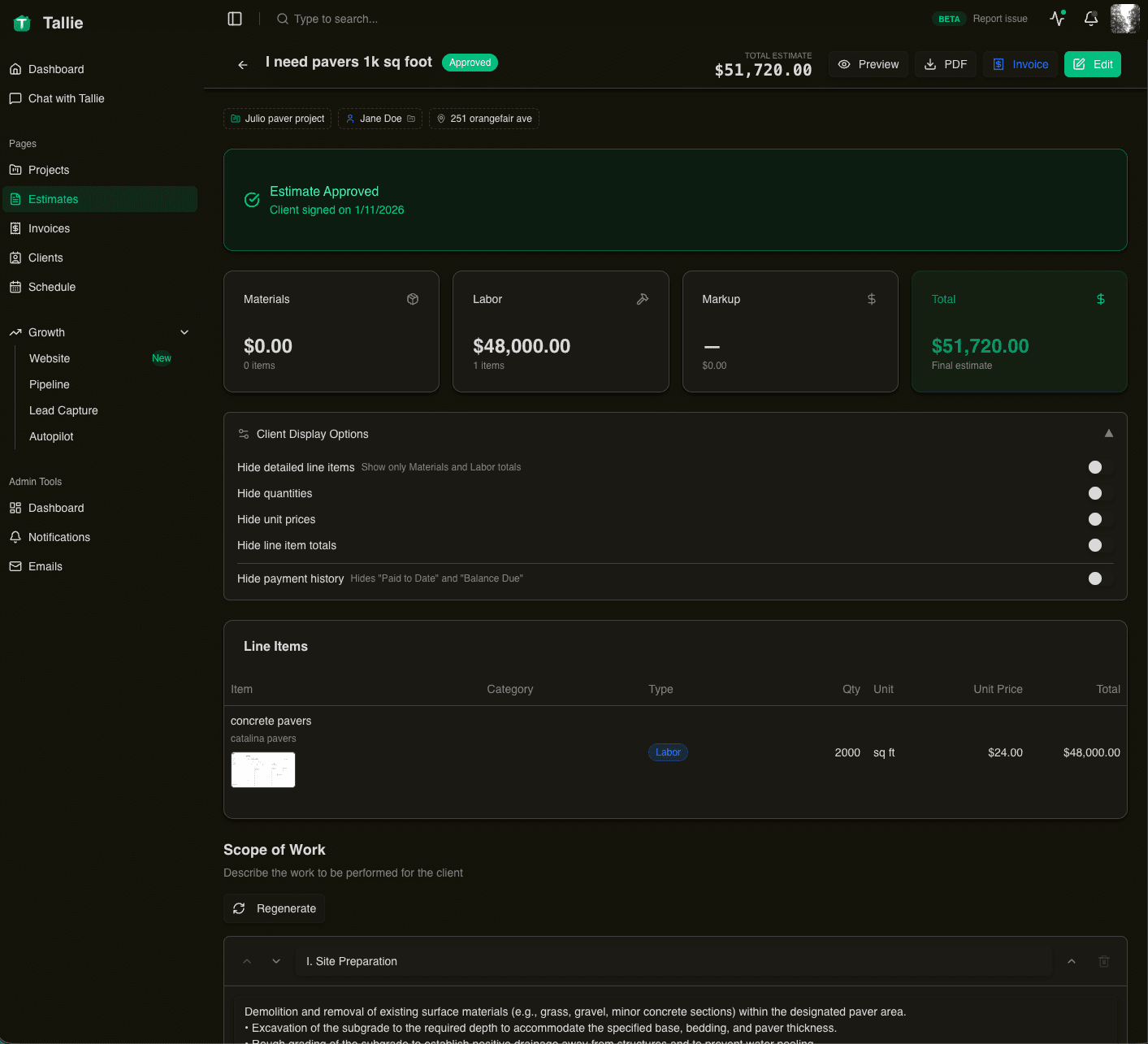
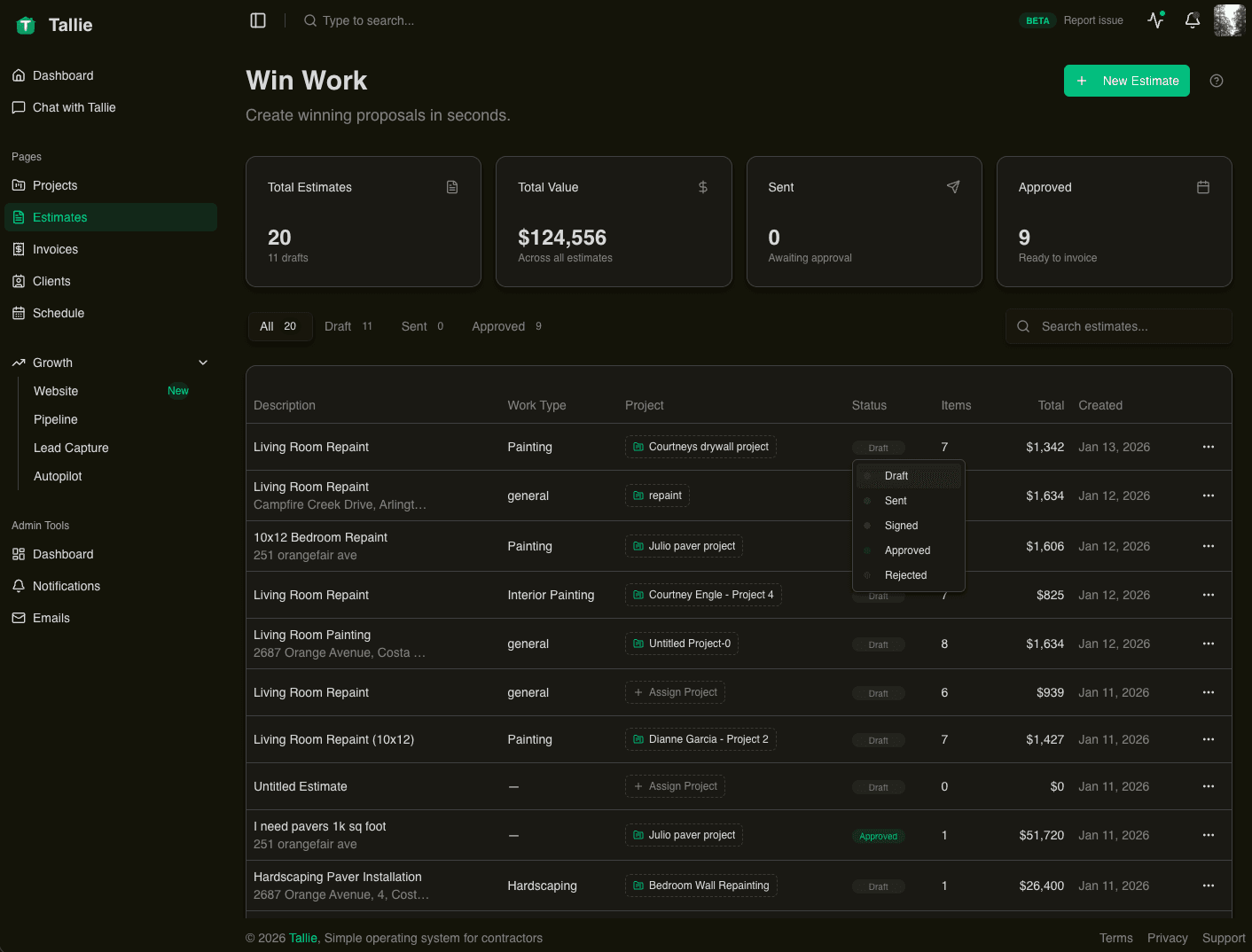
What it looks like
Tallie is a good fit if
- Trades where each job differs enough that templates do not help
- Contractors whose material costs move faster than they update price lists
- Anyone spending more than half an hour per estimate
- Businesses that lose bids to slower turnaround rather than to price
Look elsewhere if
- Flat-rate service work already priced from a good book
- Commercial bids needing measured takeoffs from drawings
- Anyone unwilling to review output before sending it
- Trades with heavily regulated or unusual pricing structures
Common questions
How accurate is AI estimating?
Accurate enough to be a strong first draft, not accurate enough to send unreviewed. Accuracy depends most on how well the job description matches reality and how well the labor rates are tuned to your market. Test on jobs whose real cost you already know.
Does it replace an estimator?
No. It removes the mechanical work of building line items and pricing materials. Judgment about scope, site conditions, and risk is still yours, and that is the part that determines whether a job is profitable.
Where does the material pricing come from?
Live supplier pricing data, with an AI-assisted fallback when a specific item is not matched. You can also import your own rate sheet as CSV or Excel and it will be categorized into materials, labor, and services.
Can I correct the estimate?
Yes. Everything generated is editable — line items, quantities, prices, labor, and markup — and you can save your own rates so future estimates use them.
How many AI estimates do I get?
About 33 a month on Starter at $29/mo, and unlimited on Pro at $79/mo. The trial includes roughly 3.
Sources
Competitor pricing verified August 3, 2026 from each vendor's public pricing page. Pricing may change.
Try it on a job you have already done
Quote a job whose real cost you already know and compare the output. That is a better test than any comparison page, including this one.
Start your 14-day free trialNo credit card required.