Service Business Software with Real Material Pricing
Which service software prices materials for you instead of making you do it?
Nearly all of them make you maintain the list yourself. Jobber and Housecall Pro both give you a price book you populate and keep current, which is accurate on the day you build it and decays from then on. Tallie prices line items against live supplier pricing instead, so material costs in an estimate reflect current pricing without you touching anything. If you buy mostly from a supplier with negotiated contract pricing, neither approach is ideal and your own imported rate sheet is more accurate than either.
How we judged
- Whether material prices come from a live source or a list you maintain
- How much work it takes to keep prices current
- What happens to margin when material costs move quickly
- Whether you can override with your own negotiated pricing
- Whether the tool handles materials at all, or only labor and flat rates
At a glance
| Option | Price | Best for | Watch out for |
|---|---|---|---|
| Tallie(us) | From $29/mo | Contractors buying retail who want current prices without maintenance | Priced at retail; your negotiated supplier rates may be lower |
| Jobber price book | From $49/mo | Businesses with stable, negotiated material costs | You own the upkeep; stale entries quietly erode margin |
| Housecall Pro price book | From $59/mo | Flat-rate service work where materials are bundled into a service price | Same maintenance burden; weaker fit for itemized custom work |
| Supplier portal + spreadsheet | $0 | Contractors with strong negotiated pricing from one supplier | Disconnected from estimates; re-keying invites errors |
Competitor pricing verified August 3, 2026 from each vendor's public pricing page. Pricing may change.
The price list decay problem
Every estimating tool built on a price book has the same structural flaw: the list is a snapshot. You populate it carefully when you set the software up, and then material costs move and the list does not. Nobody schedules time to re-price a catalog, so it quietly drifts.
The damage is invisible because each individual estimate still looks right. You only find out at the end of the job, when the materials cost more than you quoted, and even then it is easy to blame the job rather than the list.
What live pricing changes
When line items price against a live supplier feed, the estimate reflects what materials cost now. There is no maintenance step, and there is no gap between the last time you updated the list and today.
The trade-off is that you are pricing against retail rather than your negotiated rate. If you have a contract account with better pricing, live retail data will overstate your cost — which is safer than understating it, but still not accurate for your business.
Use your own rates when you have them
If you have negotiated pricing, that is more accurate than any external feed and you should use it. Tallie imports a rate sheet from CSV or Excel and categorizes the entries into materials, labor, and services with units, so your own numbers take precedence where you have them.
The sensible setup for most contractors is a hybrid: your negotiated rates for the items you buy constantly, live data for everything else. That covers the long tail of one-off materials without you having to catalog them.
Why this matters more than it used to
Material costs have been unusually volatile in recent years, and volatility is what turns a stale price list from a minor annoyance into a margin problem. A list that is six months old is fine in a flat market and expensive in a moving one.
We are not going to quote a percentage figure for how much margin this costs the average contractor, because we do not have data we would stand behind. The mechanism is straightforward enough without a statistic attached to it.
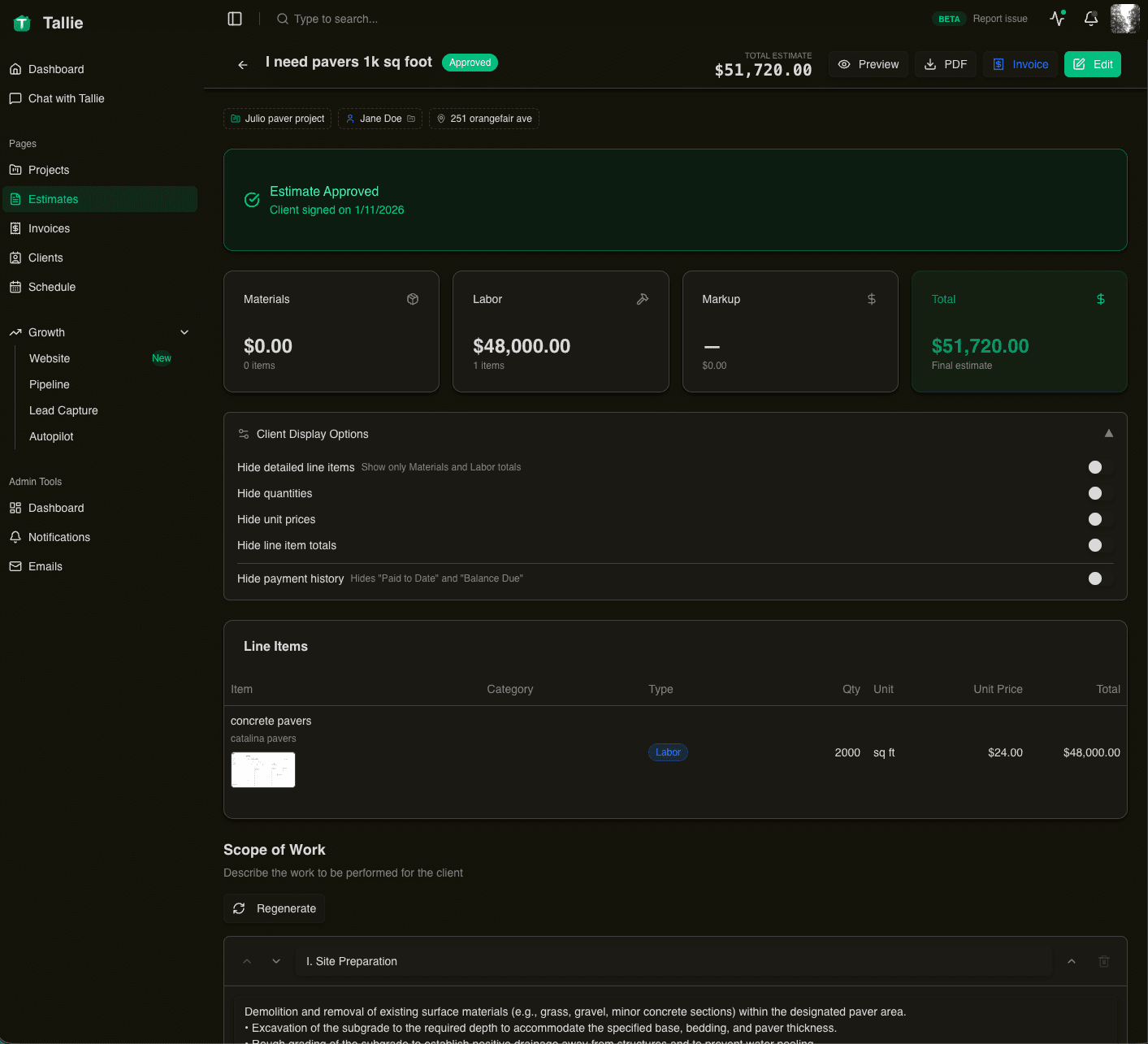
What it looks like

Tallie is a good fit if
- Trades where materials are a large share of job cost
- Contractors who buy retail rather than on a contract account
- Anyone who has been burned by quoting from an out-of-date price list
- Businesses quoting varied jobs with different materials each time
Look elsewhere if
- Contractors with strong negotiated supplier pricing — import your own rates instead
- Pure labor businesses with negligible materials
- Flat-rate service work where materials are already baked into the price
- Trades relying on specialty suppliers not covered by retail catalogs
Common questions
Where does the material pricing come from?
Live supplier pricing data, with an AI-assisted fallback when a specific item cannot be matched. You can override any line, and imported rate sheets take precedence.
What if I buy from a supply house instead?
Import your rate sheet as CSV or Excel. Your rates are used for the items you have priced, and live data covers everything else, which is usually the more accurate combination.
Does Jobber or Housecall Pro have live material pricing?
Both offer price books that you populate and maintain. Neither pulls live retail pricing into estimates the way Tallie does. Their approach is better if your costs are stable and negotiated.
Can I add markup on materials?
Yes. Set a markup that applies to material lines, and adjust it per estimate when a job warrants it.
Can I test this on a real job?
Yes — the 14-day trial needs no credit card. Quote a job you have already bought materials for and compare the estimate against your actual receipts. That is the only test that matters.
Sources
Competitor pricing verified August 3, 2026 from each vendor's public pricing page. Pricing may change.
Try it on a job you have already done
Quote a job whose real cost you already know and compare the output. That is a better test than any comparison page, including this one.
Start your 14-day free trialNo credit card required.